
A Criminal Inquisition Upon the High Priest of the Federal Reserve, Wherein the Dogs of War Are Loosed Upon the Marble Sanctum and the Republic Trembles at the Brink of Monetary Despotism
In the shadowed vaults of Washington, where the marble halls echo with the whispers of ambition and the creak of ancient mechanisms turning inexorably towards fate, I, The Political Van Helsing, take up my quill once more. The fog of intrigue descends upon this republic, thick as the mists that shroud the Thames in autumn, and I must pierce it with the lancet of truth. For what we witness is no mere squabble of statesmen, no pedestrian clash of policy and power, but a mythic struggle, a danse macabre between the guardians of gold and the sovereign who would bend them to his will. The air is heavy with the scent of brimstone and betrayal, and the hour grows late. The dogs of war are loosed, and their howls reverberate through the corridors of the Federal Reserve.
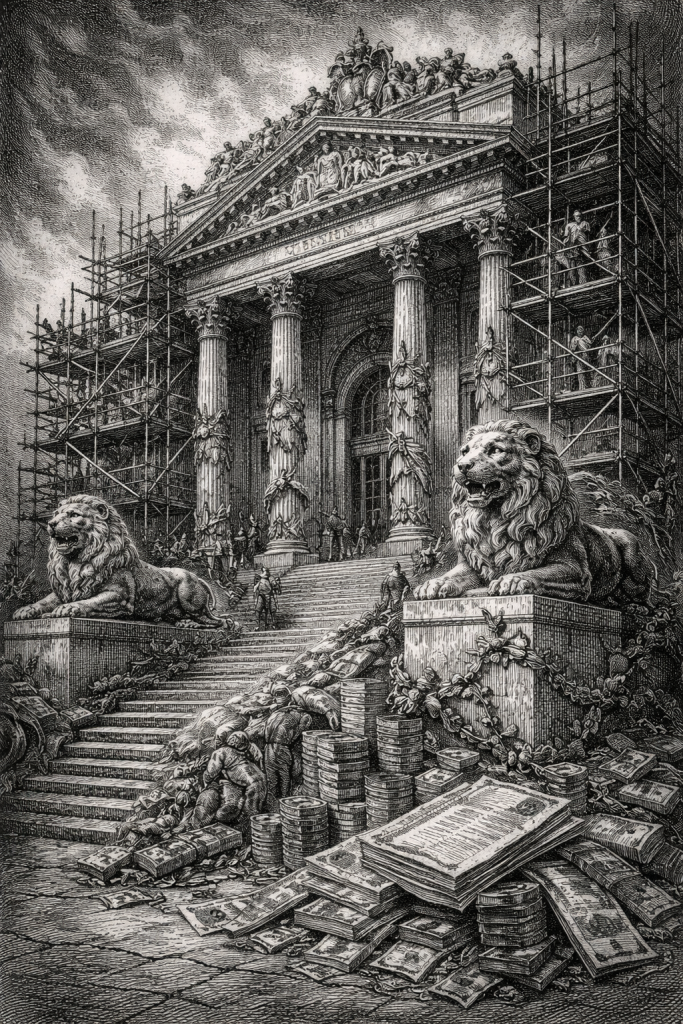
Ah, gentle reader, allow me to draw you into this labyrinthine tale, where the veil between the mundane and the monstrous thins to a gossamer thread. It begins, as such epics often do, with a edifice of stone and secrets: the headquarters of the Federal Reserve, that august temple to the alchemy of currency, now ensnared in a scandal that reeks of excess and deception. A renovation project, commenced in the year of our Lord 2022, ballooning to the staggering sum of two and a half billion dollars—seven hundred million beyond its ordained bounds. Asbestos-laced walls, leaden pipes, and whispers of luxuries unfit for public servants: private elevators ascending to forbidden heights, dining chambers reserved for the elite, marble facades gleaming with opulent deceit. And at the heart of this architectural abomination stands Jerome H. Powell, the Chair, whose testimony before the Senate in June of 2025 now hangs like a noose about his neck.
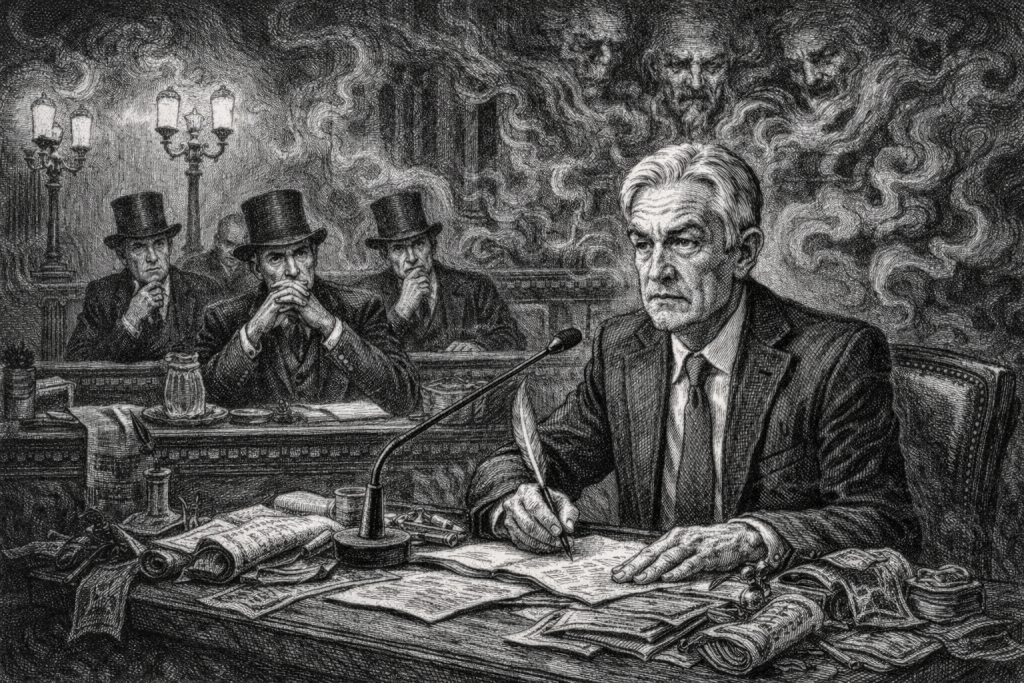
Picture it, if you will: Powell, a figure of stern Victorian propriety in this modern age, seated before the inquisitors of Congress, denying the extravagances with a composure that bordered on the sepulchral. “There’s no V.I.P. dining room; there’s no new marble,” he intoned, his voice steady as the pendulum of a grandfather clock marking the hours to midnight. “We took down the old marble, we’re putting it back up. We’ll have to use new marble where some of the old marble broke. But there’s no special elevators. There’s just old elevators that have been there.” Yet the documents, those silent accusers unearthed from the Fed’s own archives, tell a different tale—a proposal from 2021 replete with rooftop terraces, water features, and amenities that evoke the excesses of a bygone aristocracy, long before the plans “evolved,” as Powell so euphemistically phrased it.
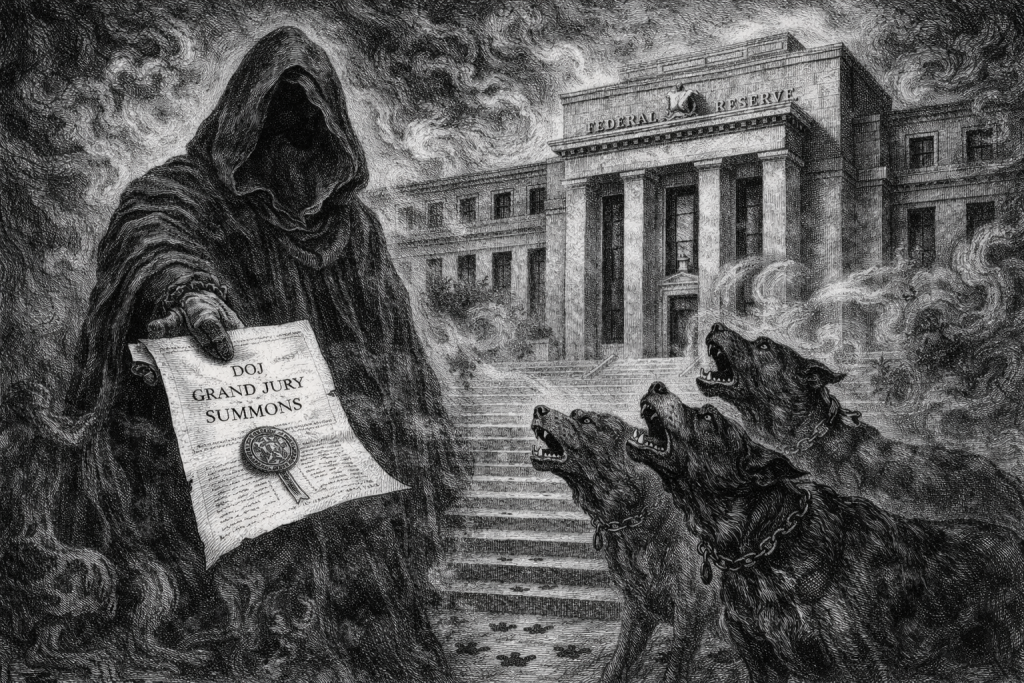
This discrepancy, this shadow-play of words, has summoned the hounds. In November of 2025, under the aegis of Jeanine Pirro—U.S. Attorney for the District of Columbia, a loyalist appointed by the resurgent President Donald J. Trump—the Department of Justice approved a criminal inquiry. Not a mere audit, mind you, but a grand jury’s summons, served upon the Fed on the tenth of January, 2026, with the explicit threat of indictment. Perjury, false statements to Congress—crimes that could fell even the mightiest of monetary overlords. The probe delves into Powell’s utterances, dissecting them like a vivisectionist in a dimly lit laboratory, comparing them against spending records and public disclosures. The air grows thick with foreboding; one can almost hear the distant tolling of bells, heralding a fall from grace.
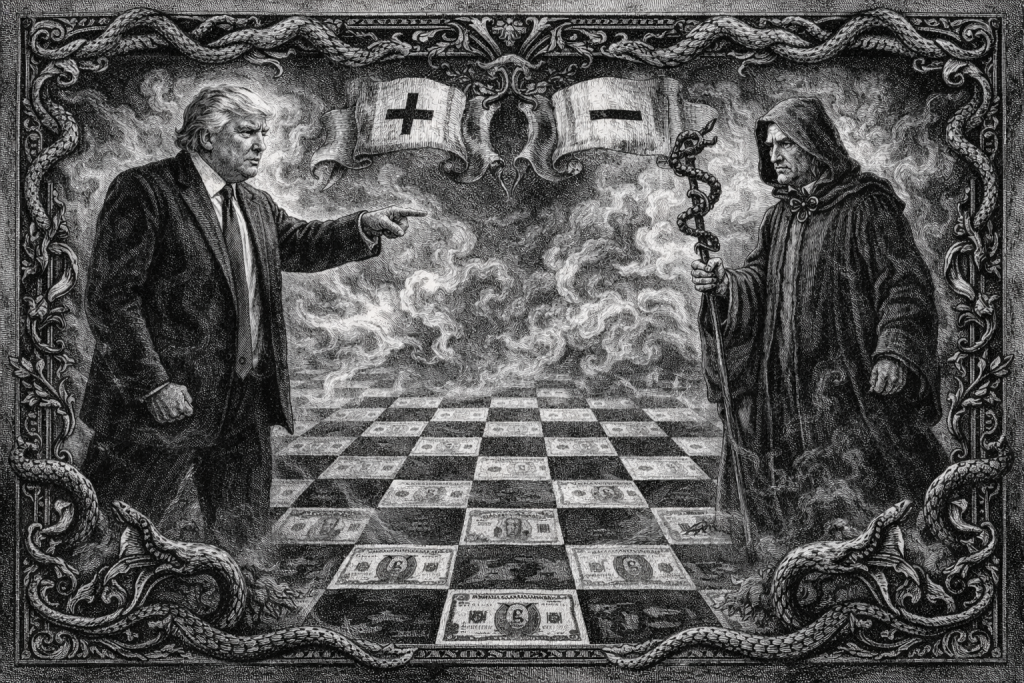
Yet this is no isolated inquisition. It is but one thread in a tapestry of mythic proportions, woven with the strands of presidential wrath and institutional defiance. Trump, that colossus returned from the political wilderness, has long viewed Powell as a thorn in his side—a holdover from his first term, nominated in 2017, now turned adversary. The President’s demands for slashed interest rates, to unleash the torrents of economic vitality, have been met with resistance. Rates linger at 3.50% to 3.75%, a restrictive yoke upon the nation’s commerce, even as inflation cools to a mere whisper of 2.6%. Trump’s tour of the renovation site in July of 2025, his accusations of “incompetence,” his threats of lawsuits and firings—these are the overtures to a symphony of retribution.
And now, the video. Oh, the folly of that spectral proclamation! Released upon the official channels of the Federal Reserve itself, late on a Sunday eve when the world slumbers and markets stir in uneasy dreams. Powell, his countenance grave as a mourner’s, addresses the camera directly: “This new threat is not about my testimony last June or about the renovation of the Federal Reserve buildings. It is not about Congress’s oversight role… Those are pretexts.” He warns of a broader peril, a shadow encroaching upon the Fed’s sacred independence: “The threat of criminal charges is a consequence of the Federal Reserve setting interest rates based on our best assessment of what will serve the public, rather than following the preferences of the president. This is about whether the Fed will be able to continue to set interest rates based on evidence and economic conditions—or whether instead monetary policy will be directed by political pressure or intimidation.”
Foolish, I say, to unmask oneself thus! To broadcast from the very bastion of neutrality a cry that reeks of partisanship, inviting the very dogs he fears. The repressed tension of the Victorian soul knows well the peril of unleashing such passions; they fester in the dark, only to erupt in horror. Powell’s words, heavy with accusation, have ignited a firestorm, markets quivering in the pre-dawn hours, futures dipping like souls into the abyss. Gold and silver ascend as harbingers of uncertainty, while the President’s allies howl in derision. Was it hubris that compelled him? Or the desperate thrash of a cornered beast, sensing the noose tighten?
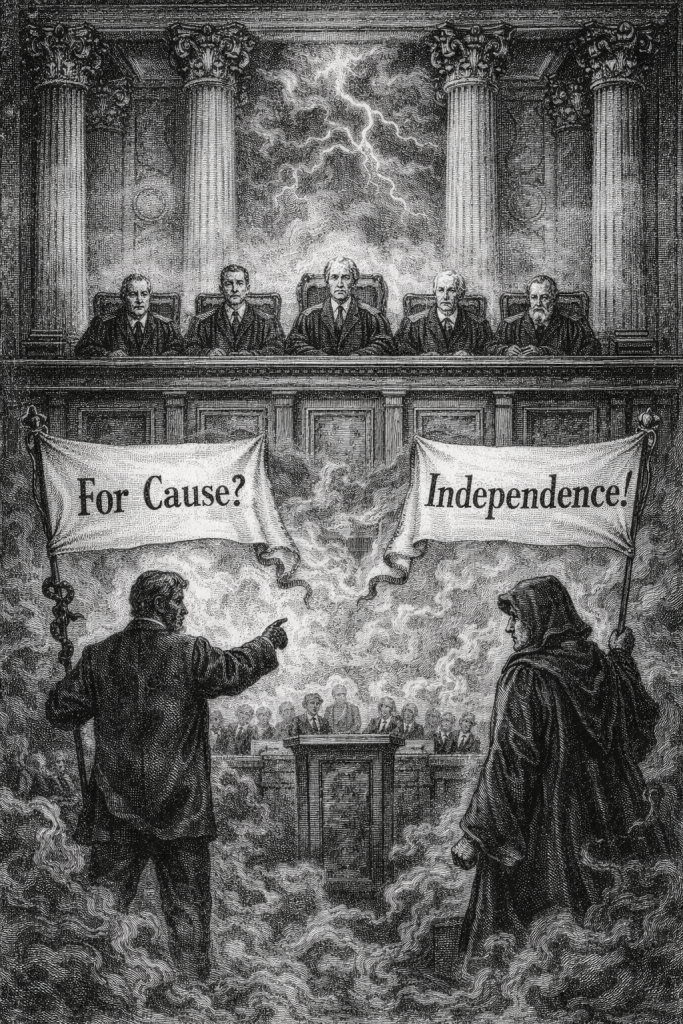
For the intrigue deepens, bordering upon the mythic, as we turn our gaze to the Supreme Court, that Olympian tribunal where fates are decreed. The case of Trump v. Cook looms like a storm cloud on the twenty-first of January, oral arguments poised to redefine the boundaries of power. Lisa D. Cook, a Fed Governor, targeted for removal over allegations of mortgage fraud predating her tenure—a charge she denies with the fervor of the innocent. The Federal Reserve Act permits dismissal only “for cause”: inefficiency, neglect, malfeasance. But what constitutes such? The Court, with its conservative majority forged in Trump’s first ascendancy, may expand the definition, instituting a test of conditions that grants the executive broader latitude. A nexus to duties, intent, proportionality, deference to presidential judgment—such a framework could empower Trump to excise dissenters like tumors from the body politic.
Imagine the scene: Justices arrayed in black robes, their chambers lit by the cold glow of precedent, debating the legacy of Humphrey’s Executor, that 1935 bulwark against arbitrary firings. Thomas and Alito, champions of unitary executive theory, may press for expansion; Roberts, the cautious steward, crafting a balanced test to avert chaos. If they rule thus, Powell’s fate seals earlier than May; the probe’s allegations—misleading Congress on marble and elevators—could meet the lowered bar, justifying removal. The repressed horror builds: a Fed remade in Trump’s image, rates plummeting to fuel his agenda, inflation lurking like a vampire in the crypt.
Yet Trump needs no such pyrrhic victory to claim his prize. Powell’s chairmanship expires in May, his governorship in 2028. The President has selected his successor—Kevin A. Hassett, top economic adviser, a front-runner poised to ascend. The Senate, with its Republican majority of 53-47, stands ready to confirm. Even Senator Thom Tillis’s theatrical vow—to block nominees until the probe resolves—crumbles under scrutiny. A lame-duck grandstander, angling for the limelight of MSNOW and CNN, his opposition is but a fleeting shadow. The Banking Committee, chaired by Tim Scott, a Trump loyalist, will advance the nomination; the floor vote requires but a simple majority. Trump gets his pick, no matter the posturing.
This urgency, this full-court press upon the economy, reveals the mythic core of the intrigue. Trump’s announcements cascade like thunderbolts: tax cuts extended, defense procurements overhauled, withdrawals from globalist funds, housing mandates with billions in bond purchases, even a cap on credit card rates at ten percent. Tariffs rise as shields against foreign predation, revenues purported to fund it all. Yet these policies demand low rates to thrive—cheap borrowing to offset inflationary spikes, to buoy growth amid softening jobs (a mere fifty thousand added in December). Powell’s restraint, his “neutral-ish” stance, acts as a dam against the flood. The probe, then, is the lever to crack it open.
Hearken now to the words of the bards, for in Pink Floyd’s “Dogs of War,” we find an echo of this shadowed contest:
“Dogs of war and men of hate With no cause, we don’t discriminate Discovery is to be disowned Our currency is flesh and bone.”
Aye, the dogs are unleashed—the DOJ’s hounds sniffing at Powell’s heels, the President’s allies baying for blood. No cause but power, no discrimination in the hunt. The Fed’s independence, that hallowed discovery of 1913, risks disownment; our currency, once backed by gold, now by the flesh and bone of political will.
The tension mounts, repressed like the secrets in a Victorian attic, where unspeakable things scratch at the floorboards. What horrors await if the Fed bends? Rates slashed precipitously, growth juiced short-term, but bubbles forming like pustules on a plagued body. Inflation reawakens, a monster from the depths, devouring savings and stability. Or if Powell stands firm, a constitutional crisis erupts, the Supreme Court’s decree igniting a conflagration. The Cook case, with its arguments in ten days, could redefine “for cause” as a malleable clay, molded by executive hands. Precedents like Comey and James, indictments tossed aside, suggest the probe may fizzle—but the process itself is the torment, legal fees and distractions sapping the spirit.
Deeper still lies the mythic undercurrent: Trump as the avenging titan, returned from exile to slay the dragons of bureaucracy. Powell as the high priest of an arcane order, guarding the elixir of monetary policy against profane touch. The renovation scandal, with its asbestos and lead, symbolizes the rot within—outdated structures crumbling under modern scrutiny. The President’s threats, his selection of Hassett, evoke the labors of Hercules, cleansing the Augean stables of federal excess.
Yet the horror is repressed, veiled in the decorum of hearings and statements. No blood spills in the streets, but the soul of the republic trembles. The dogs of war prowl, their eyes gleaming in the dark, as markets quiver and citizens await the dawn. Will Trump forge a new era, rates flowing like rivers to irrigate his vision? Or will the Fed’s independence endure, a bastion against the storm?
In this foreboding hour, I, The Political Van Helsing, urge vigilance. The intrigue borders on the mythic, but its resolution will shape our mortal realm. Pray, gentle reader, that the light pierces the gloom before the monsters claim their due.