
An Epistle Against the Desecration of Sacred Spaces
In the shadowed annals of this modern age, where the gas-lamps of progress flicker uncertainly against the encroaching gloom of moral decay and societal unrest, I, Professor Abraham Van Helsing, once more take up my quill to recount a tale that stirs the very marrow of my bones. It is the year of our Lord—nay, the calendars of these latter days proclaim it January 19, 2026, yet the eternal struggle remains unchanged: the forces of darkness, whether clad in the spectral robes of the undead or the fervent banners of mortal ideologies, assail the bastions of light, and only the vigilant soul, armed with unyielding faith and the armaments of divine truth, may repel them. From my sanctum in Amsterdam, where the canals whisper secrets of ancient evils and the fog-shrouded spires of churches stand sentinel against the night, tidings reached me of a dire profanation in the distant wilds of Minnesota, that vast American frontier where the endless prairies meet the iron grip of burgeoning industry and the ceaseless hum of political discord.
Ah, gentle reader, allow me to transport you across the vast Atlantic, beyond the roiling waves that once bore the doomed Demeter to England’s shores, to the city of Saint Paul—a place of twin spires and frozen rivers, where the winter winds howl like the restless spirits of the damned. It was upon a Sabbath morn, the 18th of January in this year of 2026, when the congregation of Cities Church gathered in reverent hush within their modest sanctuary. The air was thick with the scent of polished wood and fresh-brewed coffee from the vestibule, a humble American custom that warms the body before the soul is kindled by the Word. Families arrived in clusters: fathers with calloused hands from honest toil, mothers cradling infants swaddled against the biting cold, children with wide eyes absorbing the stained-glass depictions of biblical heroes, and elders whose faces bore the lines of lives lived in devotion. The lead pastor, Jonathan Parnell, a man of sturdy frame and gentle demeanor, ascended the pulpit, his voice resonant as he invoked the blessings of the Almighty upon the assembly.
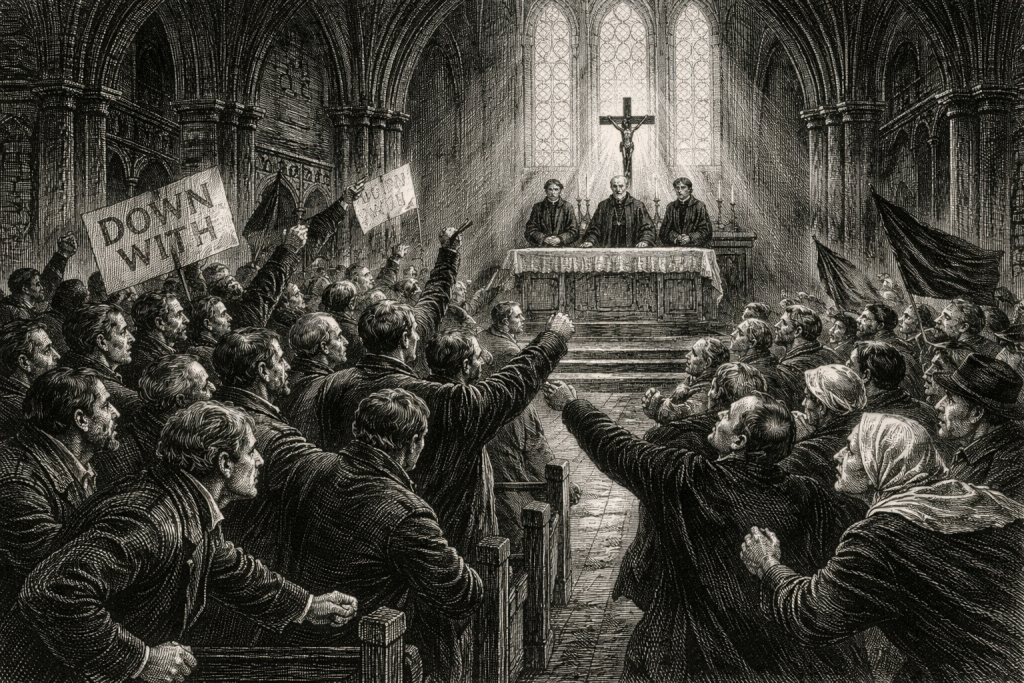
Yet, into this hallowed precinct, this fortress of faith amidst the tumult of a divided republic, burst a throng of intruders—a legion of agitators whose footsteps echoed like the thunderous approach of a Carpathian storm. Led by activists from Black Lives Matter Minnesota and the Racial Justice Network, their cries rent the air, drowning the sacred liturgy in a cacophony of earthly grievances. “Justice for Renee Good!” they bellowed, their voices a choral assault that shattered the serenity. “ICE out! No more deportations!” Among this chaotic horde stood a figure of particular note: one Don Lemon, a herald of the modern ether-waves, once a prominent voice on the illuminated screens of CNN, now wielding a device to capture the pandemonium for the world’s insatiable gaze. He live-streamed the intrusion, his lens a cold eye that broadcast the desecration far and wide, turning a private act of worship into a public spectacle of division.
The protesters surged forward, their placards waving like the banners of an invading army, confronting Pastor Parnell over the role of one of his associate pastors, who served as the acting director of the local ICE field office—a guardian of borders in a land built upon the promise of ordered liberty. Children whimpered in fear, clinging to their parents’ legs; elders rose unsteadily, their prayers interrupted by shouts that profaned the very air. The service ground to a halt, the hymns silenced, the Word unspoken, as federal agents later deemed this an act warranting investigation by the Department of Justice for potential violations of civil rights. But to my eyes, schooled in the horrors of Transylvania and the subtle corruptions of the soul, this was no mere political fray—it was a desecration akin to the foul occupations of yore, a miasma of unrest that invited the shadows to linger where light should reign supreme.
In my visions, conjured from dispatches carried on the wings of modern telegraphy—nay, the invisible threads of the internet—I beheld this intrusion as an echo of the ruined chapel at Carfax Abbey, that forsaken edifice in Stoker’s chronicle where once I pursued the dread Count Dracula himself. Recall, if you dare, the crumbling stone walls of Carfax, overgrown with ivy like the tendrils of forgotten sins, its deconsecrated chapel a vault of decay. There, the Count ensconced his fifty boxes of profane Transylvanian earth, those cursed coffins that sustained his unholy vitality. The air within was foul, thick with the stench of mold and rat droppings, the scurrying vermin his loyal minions, drawn to the aura of death. No crucifixes gleamed upon those walls; only the pall of eternal night prevailed, turning a house of God into a lair of vermin and eternal damnation. We hunters—myself, Jonathan Harker, Arthur Holmwood, and the valiant Quincey Morris—entered that accursed place armed with holy wafers, garlic, and stakes hewn from sacred wood, our hearts fortified by prayer against the vampire’s insidious influence.
So too, in this Minnesotan miasma, the intruders profaned the living temple, their rage a shadow that mocked the divine order, transforming a place of communion into a battlefield of mortal passions. The chants of the protesters, rhythmic and unrelenting, evoked the hypnotic thrall of Dracula’s gaze, drawing unwitting souls into a vortex of chaos. Don Lemon’s camera, that mechanical eye, captured not just the physical disruption but the spiritual fracture, broadcasting it to a world already besieged by division—much as the Count’s corruption spread through the veins of his victims, turning Lucy Westenra from a blooming English rose into a predatory “bloofer lady” who preyed upon the innocent children of Hampstead Heath.
But the horror deepens, dear reader, for this profane siege evoked echoes from realms beyond the veil, from the chronicles of that modern bard of terrors, Stephen King, whose tale of ‘Salem’s Lot paints a canvas of small-town America overrun by the undead. In that forsaken hamlet of Jerusalem’s Lot, Maine—shortened to ‘Salem’s Lot by the locals in their Yankee brevity—the ancient vampire Kurt Barlow, a being of primordial evil with eyes like glowing coals and a form that shifted between aristocratic poise and monstrous decay, orchestrated a plague of undeath. Barlow, like the suave Count Dracula, was a Type One vampire, a master whose origins stretched back to the mists of antiquity, his power absolute and his contempt for humanity profound.
The most chilling desecration in King’s narrative unfolds not within the church itself but in the Petrie family home, where Barlow confronts Father Donald Callahan, the town’s faltering Catholic priest. Callahan, a man tormented by doubts and the bottle, stands as the last bastion of faith in a town succumbing to the night. Armed with a crucifix that gleams with latent holy power and a vial of holy water, he shields young Mark Petrie from the vampire’s grasp. Yet Barlow, with a voice like the rustle of grave cloths, mocks the priest’s wavering conviction: “The cross… only symbols,” he hisses, his elongated fingers plucking the sacred emblem from Callahan’s trembling hand as if it were a child’s toy. In that moment, the crucifix’s power fails—not because of any inherent weakness in the symbol, but due to the erosion of faith within the wielder.
Barlow then forces upon Callahan a draught of his own corrupted blood, a perverse inversion of the Holy Eucharist, marking the priest as “unclean” without fully consigning him to vampirism. Defeated and damned, Callahan flees to his own St. Andrew’s Church, that Gothic structure with its steeple piercing the foggy skies, only to be repelled at the threshold: the doors burn his flesh like brands from hell, the holy ground rejecting his tainted soul as surely as the Gerasene tombs harbored the possessed. This spiritual invasion, this corruption of the church’s guardian, profanes the sacred from within, rendering the sanctuary vulnerable to the encroaching horde of Type Two vampires—Barlow’s lesser spawn—who infest homes and streets like a biblical plague.
In Saint Paul, the protesters’ assault upon Pastor Parnell mirrored this violation: an intrusion that sought to undermine the shepherds of the flock, questioning their earthly roles in immigration enforcement and border security, turning the pulpit into a platform for political harangue rather than divine proclamation. The presence of families and children, scattered in fear, evoked the terror of ‘Salem’s Lot’s innocents falling prey to the night creatures, their cries a lament for lost sanctity.
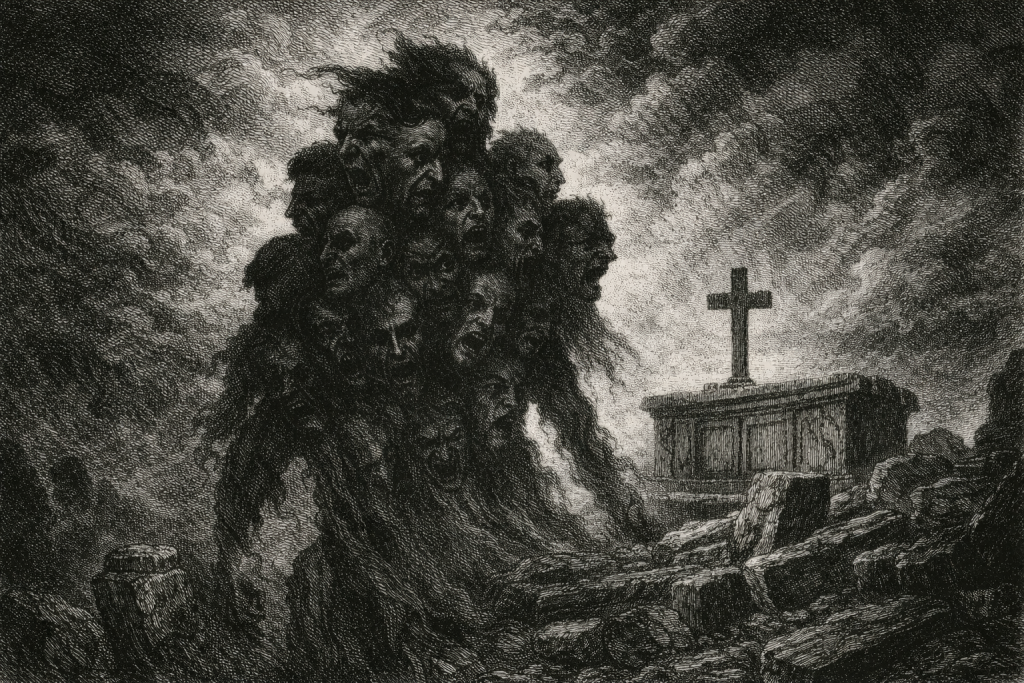
Deeper still into the abyss of symbology we plunge, for this legion of disruptors brought to mind the biblical abomination of the Gerasene demoniac, that wretched soul possessed by a multitude of unclean spirits who collectively proclaimed, “Legion, for we are many.” As chronicled in the Gospels—Mark 5:1–20, Luke 8:26–39, and a variant in Matthew 8:28–34—this tormented figure dwelt among the tombs on the eastern shore of the Sea of Galilee, in the region of the Gerasenes (or Gadarenes, as some manuscripts attest). These burial caves, hewn into the rocky hillsides, were places of death and ritual impurity under Mosaic law, shunned by the living as abodes of ghosts and defilement.
The demoniac was a pitiable sight: naked and feral, his body scarred from self-inflicted wounds with sharp stones, his cries echoing through the night like the wails of lost souls. No chains forged by human hands could bind him; with superhuman strength, he shattered fetters and roamed the graves, a living emblem of chaos incarnate. When Christ approached, the legion within him recognized the divine authority, begging not to be cast into the abyss but permitted to enter a nearby herd of swine—unclean animals themselves—which then plunged madly into the sea, drowning in the depths. With a word, Jesus liberated the man, restoring him to sanity: clothed and in his right mind, he sat at the Master’s feet, a testimony to mercy triumphant.
This archetype of possession, of unclean spirits infesting the sacred vessel of humanity and dwelling in places of death, parallels the Minnesotan intrusion with eerie precision. The protesters, a collective “legion” driven by fervent ideologies, stormed the church—a living tomb momentarily profaned— their vehement shouts and disruptions akin to the demoniac’s self-lacerations and uncontrollable fury. In a republic grappling with borders, justice, and identity, such acts invite a spiritual miasma, where division festers like demons in the soul, eroding the communal bonds that faith seeks to forge.
But lo! Amid this tapestry of horror, a spark of resurgence ignites, drawing from the very fount of divine authority as exemplified in the act of our Lord Jesus Christ Himself cleansing the Temple. In the Gospels—Matthew 21:12–13, Mark 11:15–17, Luke 19:45–46, and John 2:13–17—we witness Christ entering the vast precincts of Herod’s Temple in Jerusalem during Passover, His eyes ablaze with righteous indignation. The outer courts, meant for prayer and the inclusion of Gentiles in worship, had been overrun by merchants selling doves and oxen for sacrifices, and money-changers exchanging foreign coins for the temple shekel at usurious rates. What was intended as a house of prayer for all nations had become a “den of robbers,” a marketplace of exploitation that barred the poor and profaned the sacred.
With zeal consuming Him like fire—echoing the Psalmist’s words, “Zeal for your house consumes me” (Psalm 69:9)—Jesus fashioned a whip from cords, overturned the tables with a thunderous crash, scattering coins across the marble floors, and drove out the beasts and traders. “My house shall be called a house of prayer,” He proclaimed, quoting Isaiah 56:7 and Jeremiah 7:11, “but you have made it a den of thieves!” This was no impulsive rage but a prophetic act of judgment, foreshadowing the Temple’s destruction in AD 70 and pointing to Christ’s own body as the true Temple, destroyed and raised in three days.
From this divine exemplar, I, Van Helsing, draw lessons profound for the guardians of faith in this turbulent era. Righteous indignation is not a sin but a holy duty when the sacred is assailed. The faithful must not cower in passivity but rise with controlled zeal, purifying the temple—be it the physical church or the temple of the body—with unyielding resolve. The intrusion in Saint Paul, like the merchants’ corruption, disrupted the core purpose of worship, turning a sanctuary into a stage for earthly clamor. Yet, as Christ restored order, so must modern believers reclaim their spaces through prayer, authority, and mercy.
In my meditations upon this Minnesotan affliction, I envisioned myself traversing the ethereal mists, summoned as of old to confront the shadows. “Van Helsing,” the winds whispered through the canals of Amsterdam, “arm thyself once more against the profane legions!” And so, in spirit, I descended upon the beleaguered Cities Church, my greatcoat billowing like the wings of a guardian archangel, my satchel laden with the armaments of faith: crucifixes forged in silver, vials of holy water blessed by the Vatican, and wafers from the consecrated Host. The winter sun cast long shadows across the snow-draped streets of Saint Paul, the Mississippi River frozen in crystalline silence, a mirror to the chilled hearts of a divided populace.
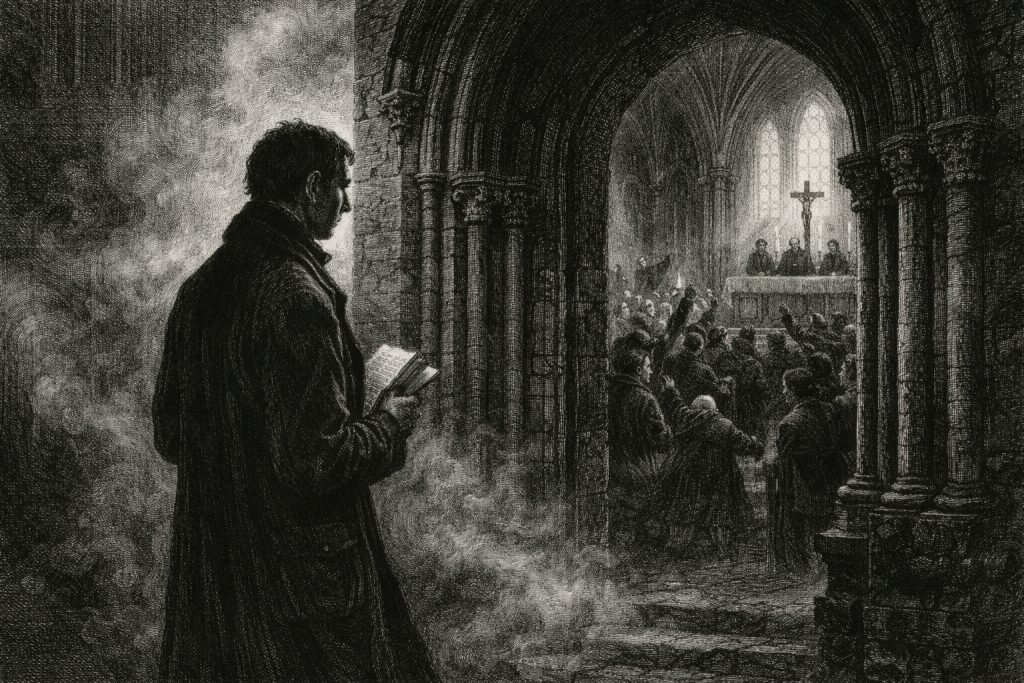
Approaching the church, a modest brick edifice with a cross-topped steeple piercing the gray sky, I imagined the echoes of the intrusion still lingering—like the foul odor that pervaded Carfax’s chapel. Inside, Pastor Parnell greeted me in my reverie, his face etched with weariness yet illuminated by an inner resolve. “Professor,” he would say, his voice steady despite the ordeal, “we have been besieged, our worship profaned. What counsel do you bring from the annals of darkness?”
“First, my good pastor,” I replied in my thick Dutch accent, my eyes scanning the sanctuary for any residual miasma, “fortify thy sanctuaries with the symbols of redemption. Place the crucifix boldly upon the altar and at every portal—entrance, exit, even the windows that admit the light of day. Consecrate them anew with prayers fervent and true, invoking the blood of the Lamb that repels all unclean spirits. Let holy water flow like a river of purification, asperged upon the thresholds and sprinkled upon the congregation at the commencement of each service, to cleanse both body and soul.”
I would demonstrate, dipping my fingers into a font and tracing the sign of the cross upon the doors, murmuring Latin incantations from the Rituale Romanum. “Next,” I continued, “crumble the blessed Host—the very Body of Christ—about the perimeters of the church grounds, forming barriers impenetrable to evil, as I once sealed the chambers of Castle Dracula against his nocturnal returns. These are not mere talismans, but extensions of divine grace, potent only when wielded with belief unassailable. Doubt, as Father Callahan discovered to his eternal sorrow, is the chink in the armor through which the shadows creep.”
Invoke the vigilance of the spirit, I urged: assemble prayer vigils, where the faithful stand as sentinels against the night, rotating in watches like the guardians of ancient Jerusalem’s walls. Let the clergy renew their vows in solemn ceremony, exorcising any doubt or worldly entanglement that might weaken their resolve—lest they suffer the fate of the Gerasene demoniac, isolated among the tombs of their own making. Consecrate the grounds afresh, with processions bearing incense and chanting psalms, banishing the miasma of intrusion as Christ banished the merchants.
And in the face of such sieges, meet them not with carnal weapons or heated rhetoric, but with the authority of Christ Himself. Command the shadows to depart in His name, as He cast out Legion into the swine, who plunged into the abyssal depths of the sea. “Be gone, ye profaners!” I would cry, imagining a future intrusion, my crucifix raised high, its glow piercing the chaos like a beacon. The protesters, confronted not with anger but with divine calm, might pause, their legion fracturing under the weight of true light.
Yet, this tale is not one of unrelenting dread, but of spiritual resurgence, a phoenix rising from the ashes of profanation with wings of renewed faith. In the aftermath of the Saint Paul incursion, whispers reached me across the oceans of federal inquisitions by the Department of Justice, probing the violation of civil sanctities with the gravity of a Victorian inquest. But true restoration lies not in earthly tribunals, though they serve their purpose in upholding the republic’s laws, but in the rekindling of faith’s flame within the hearts of the faithful.
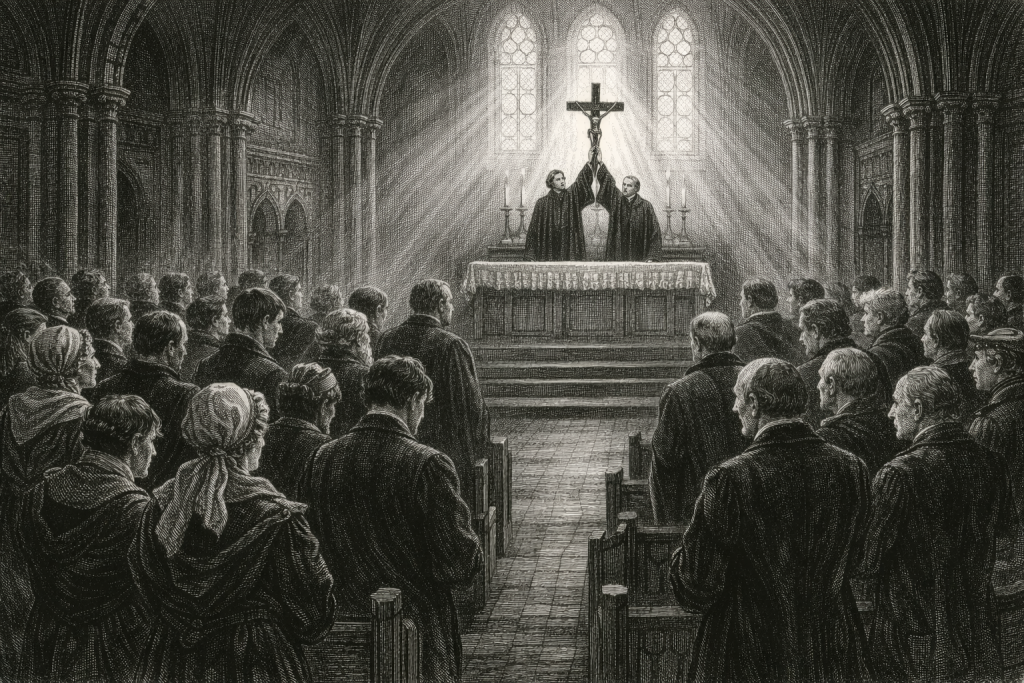
The congregation, shaken yet unbroken, gathered once more in the days following, their voices swelling in hymns that drowned the echoes of chaos. Families clasped hands in unity, elders imparted wisdom drawn from Scripture, and the young beheld the triumph of light over shadow, their innocence preserved through the storm. Pastor Parnell, fortified by the ordeal, preached with renewed vigor on the themes of mercy and justice, drawing parallels to Christ’s own confrontations, reminding his flock that the church stands as a refuge for all, yet must guard its sanctity against all forms of desecration—be they political, spiritual, or infernal.
I see in this a greater awakening rippling across the American Republic, a land vast and varied, beset by intrigues as labyrinthine as the Carpathian mountains. Churches from the bustling streets of New York to the sun-baked plains of Texas arm themselves against the miasmas of division, their pastors invoking the zeal of the Temple cleanser. Prayer groups multiply like the loaves and fishes, vigils illuminate the night, and the symbols of faith—crucifix, wafer, holy water—become everyday armaments in the eternal war.
The vampire of corruption, whether lurking in the halls of power with their decrees on borders and justice, or manifesting in the streets through protests that veer into sacrilege, finds its stake in the unified zeal of the faithful. As in my battles with Dracula, where we hunters pierced the heart of evil with stake and prayer, driving back the night to reclaim the dawn, so too must modern guardians reclaim their temples from the profane.
And thus, dear reader, the Minnesotan miasma resolves not in despair, but in exaltation—a testament to the resilience of the human spirit under divine guidance. The shadows retreat before the advancing light, the sacred flames burn brighter than before, and the Republic, though tested by the fires of discord, finds solace in the eternal verities of faith, order, and mercy. I, Abraham Van Helsing, political sentinel and slayer of unholy tyrannies both spectral and societal, bid thee heed this chronicle: guard thy sanctuaries with vigilance unending, wield thy faith as a sword forged in heaven’s fire, and let the resurgence of the spirit banish the horrors of the age. For in the end, as the Scriptures attest in John 1:5, “The light shineth in darkness; and the darkness comprehended it not.” May this truth guide us all through the mists of uncertainty, until the final dawn breaks eternal.