
An Exposition Upon the Fallacious Notion of the Decennial Delay in the Revivification of Venezuelan Petroleum: A Treatise on the Vigour of American Enterprise and the Shadows of Beltway Sophistry
In the sombre precincts of our Republic’s capital, where the effluvium of bureaucratic intrigue gathers thickly like the exhalations of some ancient and pestilential marsh upon the lowlands of the Thames in autumn, there lurks a cadre of self-proclaimed sages—those denizens of the lanyard class, adorned with their badges of office and cloaked in the garments of academic pretension—who presume to cast aspersions upon the bold endeavours of our Chief Magistrate, President Donald J. Trump, in the matter of Venezuelan oil. With voices raised in a chorus of feigned consternation, they proclaim that the resurrection of that beleaguered nation’s petroleum riches shall demand no less than a decade of toil, rendering the entire enterprise a quixotic folly, a chase after phantoms in the gloaming. Such utterances, emanating from the lips of skeptics like the learned Mrs. Juliette Kayyem in her recent epistle upon the electronic gazette known as X, betray not merely a deficiency in comprehension but a deliberate obfuscation, a veil drawn across the luminous truths of industrial fortitude and national resolve.

Yet, it is I, Professor Abraham Van Helsing, through spectral vigilance inspires these pages, piercing through this fog of dissimulation with the keen blade of inquiry. For it is the very essence of the oil industry’s vocation to embark upon ventures of protracted gestation, fraught with peril and uncertainty, much as the intrepid explorers of yore ventured into uncharted realms, braving tempests and savages for the promise of imperial bounty. Venezuela, with its vast subterranean treasures—reservoirs of black gold exceeding three hundred billion barrels, the mightiest hoard upon the globe—presents itself not as an insurmountable labyrinth but as a domain ripe for reclamation, its dilapidated engines of extraction awaiting the masterful hand of American ingenuity. Under the aegis of United States oversight, the erstwhile barriers of sanctions, corruption, and adversarial encroachment are swept away like cobwebs from a long-sealed crypt, revealing pathways to swift augmentation and enduring prosperity.
This treatise shall elucidate the fallacies of the decennial myth with the meticulous care of a horologist assembling a grand complication, delineate the temporal rhythms of petroleum development through a symphony of historical and contemporary examples, celebrate the enduring audacity of our oil titans as paragons of capitalist resilience, repel the insidious critiques of the lanyard elite with the unyielding force of empirical logic, delve into the profound decay inflicted upon Venezuela by the Maduro regime as a cautionary chronicle of socialist perdition, examine the technological marvels that compress timelines and confound pessimists, and culminate in a resounding proclamation of hemispheric sovereignty under the banner of the Trump Corollary to the Monroe Doctrine. For this is no mere commercial affair; it is the restoration of American dominion in our own hemisphere, a bulwark against the encroachments of distant despots, a symphony of enterprise that harmonizes economic might with geopolitical strategy, and a beacon of ordered liberty in a world darkened by the shadows of tyranny and misrule.
The Spurious Chronology
To commence our disquisition, we must first unravel the spurious assertion that the revivification of Venezuelan oil production is inexorably tethered to a span of ten years or more, a period invoked by the detractors as though it were an immutable decree of Fate herself. This notion, propagated with the zeal of a Victorian doomsayer foretelling the collapse of the Crystal Palace amid the industrial revolutions of our age, derives from a myopic interpretation of the extractive arts, ignoring the nuanced interplay of science, capital, and will that defines such pursuits. In truth, the chronology from the reactivation of dormant wells to the gushing forth of crude elixir is a tapestry woven from diverse threads: the geological peculiarities of the terrain, the sophistication of mechanical apparatuses, and the exigencies of locale, each contributing to a timeline that is as variable as the moods of the sea.
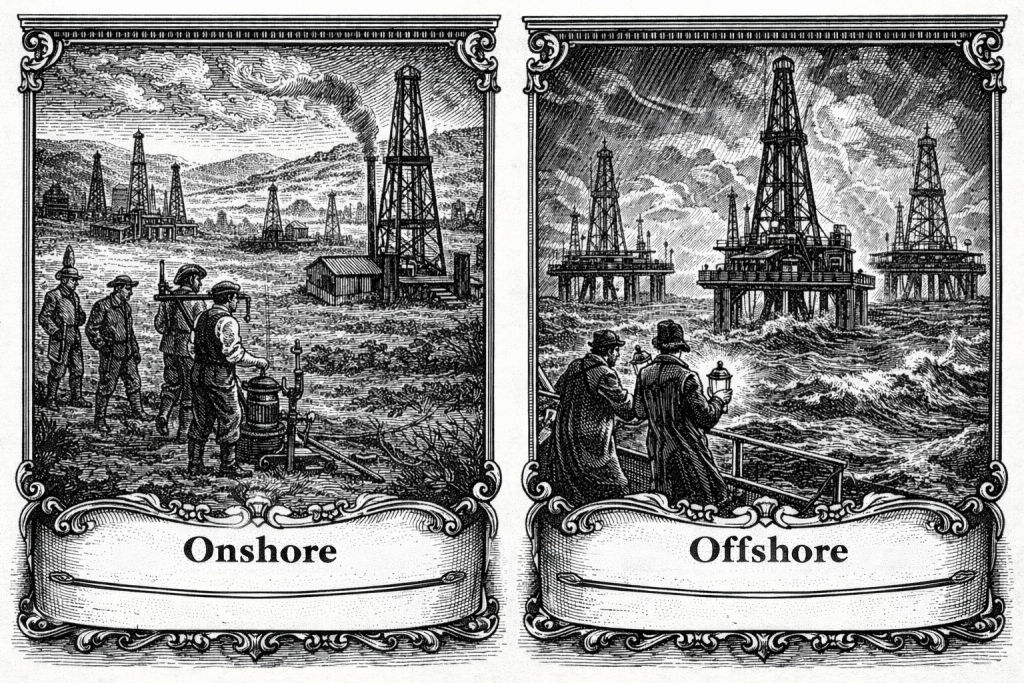
Consider, for instance, the conventional onshore fields, which abound in the Orinoco Belt like hidden jewels in a forgotten mine; here, the interval may span but three to five years from the solemn decree of investment to the triumphant delivery of product. Whereas ventures into the abyssal depths offshore, or those contending with the viscous humours of heavy crude—thick and recalcitrant as the bitumen of ancient Assyria—might extend to five or even ten years, demanding the deployment of submersible apparatuses and thermal injections to coax the reluctant flow. The shale formations of our own Permian Basin offer a striking counterpoint to this narrative of delay: there, the alchemical process from perforation to yield unfolds in mere lunar cycles—drilling accomplished in a fortnight or two, completion in but a few weeks thereafter, a testament to the hydraulic fracturing techniques that have revolutionized the American energy landscape since the turn of the millennium.

Venezuela’s extra-heavy crude, akin to the bituminous sands of Canada or the tar pits of La Brea, demands enhanced recuperative methods such as steam-assisted gravity drainage or solvent injection, yet historical precedents affirm that from the moment of investment decree to initial effusion, a mere two to three years may suffice, propelled by innovations such as digital simulacra for reservoir modeling, automated drilling rigs that operate with the precision of a Swiss chronometer, and modular apparatuses that can be assembled on-site like the prefabricated structures of the Great Exhibition. Globally, the mean duration from discovery—or, in this instance, resuscitation—to productive flow has diminished to five to seven years in recent epochs, a contraction from the more languid paces of the prior decade, owing to the march of technological prowess that has accelerated every phase of development.
The International Energy Agency itself attests that lead times have been steadily compressed through the application of seismic imaging, which maps the earth’s hidden chambers with the accuracy of a phrenologist charting the skull, automated drilling that reduces human error to a whisper, and predictive analytics that forecast outcomes with prophetic clarity. In the broader mineralogical domain, encompassing analogues to oil such as the extraction of rare earths or precious metals, the aggregate timeline approaches seventeen years, yet the preponderance thereof—twelve years or more—is consumed in exploratory forays, environmental supplications to appease the guardians of nature, and regulatory entanglements with the bureaucratic leviathan. These phases are mercifully obviated in Venezuela, where the fields lie proven and partially hewn, their reservoirs already mapped by decades of prior exploration, their wells, though idle and encrusted with the rust of neglect, still capable of revival with comparatively modest intervention, much as a dormant steam engine requires but oil and fire to roar back to life.
The critics, in their haste to decry, overlook this elemental distinction, equating the rejuvenation of extant reservoirs with the virgin conquest of unknown strata, a fallacy as egregious as mistaking the restoration of Westminster Abbey—its ancient stones polished and arches reinforced—for the erection of a new Gothic pile from the foundations, complete with quarrying and architectural invention. Particular to Venezuela, the oracles of industry—those seers at Rystad Energy, the ANZ Banking Consortium, and Goldman Sachs—prognosticate initial surges within one to five years, with plenary restoration to three million barrels per diem necessitating ten to fifteen years and an infusion of fifty-three billion dollars in upstream capital, a sum that, though vast, pales beside the trillions mobilized for global energy transitions.

President Trump’s delineation, promulgated in the nascent days of January 2026 amid the echoes of the raid that felled Maduro, envisions American enterprises attaining full operational vigour within eighteen months, emphasizing expeditious triumphs such as the refurbishment of upgraders—those colossal alchemical furnaces that transform heavy crude into marketable elixir—a task estimated at no more than three years, drawing upon modular construction techniques that have shortened similar projects in the North Sea and the Gulf of Mexico. Such aspirations, though bold as the charge of the Light Brigade, find echo in the annals of post-sanction Iraq, where output doubled in under four years through the influx of foreign wherewithal and technical expertise, and in the swift revival of Libyan fields following the fall of Qaddafi, where production rebounded dramatically within two years of stabilized governance, proving that political will can compress timelines as surely as pressure transforms coal into diamond.
To double Venezuela’s current yield of one million barrels daily might transpire in but three years, harnessing the refineries of our Gulf Coast, attuned as they are to the ponderous character of its crude, facilities built in the mid-twentieth century precisely for such heavy feeds and now standing ready to absorb the surge. The specter of a “ten-year” impediment? It pertains to the outermost bounds of field longevity—fifteen to thirty years from inception to exhaustion—not to the inaugural ramparts of production, and even then, it is a horizon that oil magnates view not as a barrier but as an invitation to legacy-building.
Since the audacious incursion of January 3, whereby our valiant forces apprehended the tyrant Maduro in a stroke reminiscent of the capture of Napoleon at Waterloo, the auguries from fiscal institutions and petroleum syndicates have further dismantled this decennial shroud. Energy Secretary Chris Wright, in his oration of January 7, foretells increments of several hundred thousand barrels per day through modest rectifications: the reanimation of idled wells, numbering some twenty-eight thousand like silent sentinels awaiting the call to arms, and the importation of diluents to attenuate the crude’s viscosity, a process as simple as diluting ink for a scribe’s quill. The sages at Goldman Sachs concur, envisioning an accretion of up to five hundred thousand barrels daily within two years, under the mantle of political equanimity and Yankee investments, elevating aggregate output to one point three to one point five million barrels from the present nadir. JPMorgan, with even greater optimism, anticipates one point three to one point four million barrels in the same biennium during transition, ascending potentially to two point five million over a decade, a trajectory that would flood global markets and depress prices to the delight of American consumers.
This exploits the extant framework—debased yet intact, like the ruins of a Roman aqueduct awaiting restoration—and the United States’ confiscation of thirty to fifty million stored barrels for instantaneous mercantile disposition, a windfall that could generate billions in revenue to seed further investments. Detractors such as Mrs. Kayyem elide these verities, but as the chroniclers of Al Jazeera admonish, “Underestimate not the prowess of United States oil concerns to augment Venezuelan yield with celerity beyond prognostication,” a warning that echoes the underestimation of American industrial might during the World Wars.
The Enduring Audacity of Big Oil
If the prospect of a decennial commitment strikes the timid as prohibitive, one must inquire whether such faint hearts have ever beheld the titans of Big Oil in their majestic stride, striding across continents like the colossi of Rhodes. These are no ephemeral speculators of the stock exchange, pursuing fleeting gains amid the bourse’s diurnal fluctuations; nay, they are colossal entities, their ledgers spanning epochs, their ambitions etched upon the very crust of the earth with the indelible ink of capital and innovation. ExxonMobil, Chevron, and their brethren habitually consign billions to precincts of exalted hazard, enduring the gales of political upheaval, the labyrinths of technical enigma, and the vicissitudes of market caprice, all for harvests that ripen years hence, much as the vineyard keeper tends his vines through seasons of drought and flood for the vintage of a lifetime.
Witness the Arctic odysseys: Shell disbursed over seven billion dollars in the Chukchi Sea concessions of Alaska during the aughts, contending with juridical postponements, ecological perils, and the harsh tyranny of polar winters for a full decade ere redirection—yet they persist in analogous protracted pursuits, their leases renewed in the faith that future technologies, such as advanced ice-breaking platforms and subsea robotics, shall render the frozen wastes productive, a gamble that mirrors the endurance of Arctic explorers like Peary and Amundsen. In Guyana, Exxon lavished forty billion dollars upon the Stabroek Block since 2015, yielding first oil in 2019—a mere four years post-detection—and now disgorging six hundred thousand barrels daily, notwithstanding territorial disputations with Venezuela itself and the challenges of deepwater drilling in equatorial seas, a paragon of venturesome wager that fructified in less than a decade, yielding returns that have bolstered Exxon’s balance sheets and secured energy supplies for generations.
State-sponsored colossi in nascent markets evince even greater temerity, hazarding four hundred billion dollars on petroleum schemes that defy the accords of Paris, oft in realms of instability such as Algeria or Nigeria, where coups and insurgencies are as common as the desert sands or the tropical rains, yet companies like TotalEnergies and Eni press on, investing in infrastructure that withstands sabotage and political shifts. Proximate to our shores, American behemoths have channeled billions into verdant alternatives concurrent with fossil pursuits—Exxon and Chevron in the sequestration of carbonic vapours through vast underground repositories, BP and Total in solar and aeolian harnesses that span deserts and offshore winds—despite gestations of ten to twenty years ere profitability dawns, a diversification that hedges against the caprices of policy and climate.
Chevron’s persistence in Venezuela itself, maintaining operations under constrained licenses at two hundred thousand barrels daily amid the regime’s hostility, demonstrates a long-suffering commitment that belies the critics’ narrative of abandonment, positioning the company to surge forward now that the shackles are removed. Private equity potentates such as EnCap, with thirty billion dollars in autonomous ventures, and Riverstone, with forty-three billion in over two hundred compacts, specialize in upstream cycles of ten to fifteen years, viewing such horizons not as burdens but as opportunities for compounded returns, much as Victorian financiers backed railways across continents, knowing that profits would accrue over decades.

The resurgence of United States tight oil—from five million barrels daily in 2008 to thirteen million anon—emanated from technological infusions over fifteen years, a transformation that confounded the doomsayers who once declared shale uneconomic, proving that innovation can turn marginal plays into gushers. The International Energy Agency attests: The fraternity invests eight hundred billion dollars annually worldwide; even amid net-zero visions, perennial capital expenditure remains imperative, for the world’s thirst for energy shall not be quenched by moral exhortations alone, but by the relentless pursuit of supply. Deloitte’s prognostication for 2026: Propitious edicts shall invigorate capital outlays, particularly with the expulsion of foes and the establishment of stable governance, drawing investors like moths to a flame.
Venezuela holds no novelty in this saga. Antecedent to Chávez’s usurpations, alien enterprises like Exxon operated there for generations, navigating insurrections and expropriations with stoic resolve, building refineries and pipelines that once made Venezuela the envy of South America, a legacy that now awaits reclamation. Even amidst the shadows of recent years, Chevron has maintained vigil, confining output to two hundred thousand barrels daily yet primed for expansion under the new dispensation. President Trump’s schema—appropriating vessels, safeguarding thirty to fifty million barrels for proximate gain, and summoning “very large U.S. oil companies” for reconstruction—harmonizes with this ethos. It demands no instantaneous panacea, but with three hundred and three billion barrels in contention—the globe’s paramount cache—the recompense eclipses the deferment, thwarting Sino-Russian machinations whilst fortifying our Republic’s energetic autonomy, and promising lower prices at the pump for the common man.
The Depths of Maduro’s Decay
To appreciate the magnitude of this opportunity, one must descend into the abyss of Venezuela’s decline under Nicolás Maduro, a regime that has reduced a once-prosperous nation to penury through a combination of ideological fanaticism, administrative incompetence, and venal corruption, a descent as tragic as the fall of Byzantium to the Ottoman horde. Since 2008, output has plummeted seventy-eight percent, from over three million barrels daily to the present nadir of one million, not through geological exhaustion but through systematic neglect: pipelines corroded like the veins of a consumptive, refineries shuttered and overgrown with weeds, wells capped and forgotten like sealed tombs, and skilled engineers driven into exile across borders, their expertise lost to the winds.
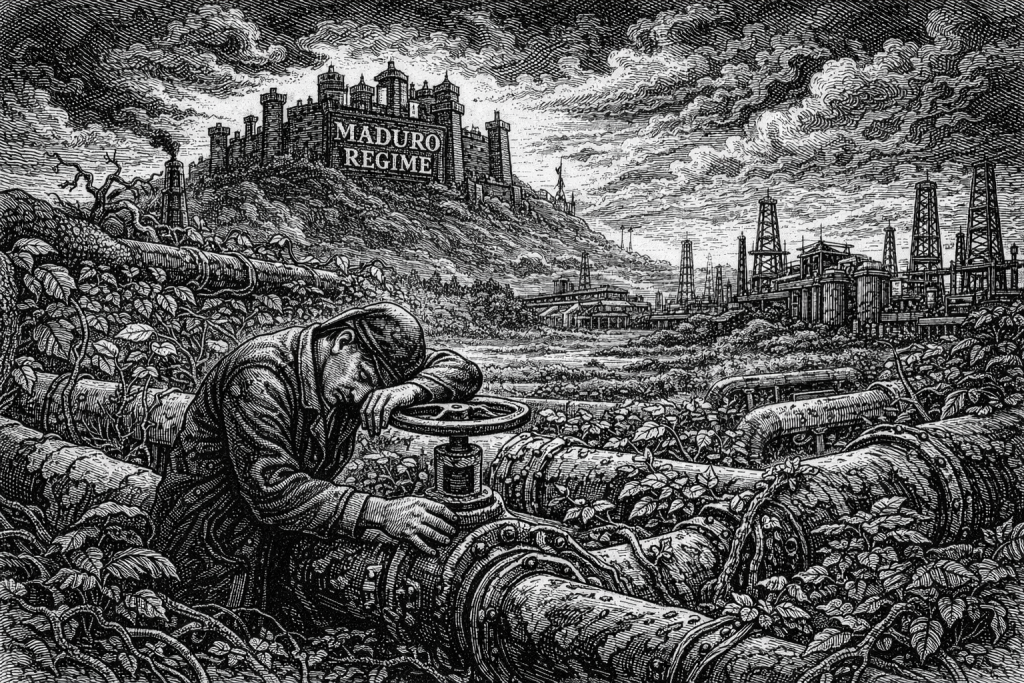
Corruption has siphoned billions into the pockets of the ruling clique and their foreign patrons, while partnerships with China, Russia, and Iran have delivered discounted crude in exchange for loans that now burden the nation like chains upon a debtor’s ankles, loans that funded not infrastructure but the regime’s survival through repression and propaganda. The Orinoco Belt, once a marvel of engineering comparable to the Suez Canal in its ambition, lies in partial ruin, its upgraders idle for want of maintenance, its diluent supplies interrupted by sanctions that the regime itself invited through its narcotic alliances and support for terrorism, alliances that turned PDVSA from a national treasure into a slush fund for global malefactors.
This decay is no accident; it is the inevitable fruit of socialist misrule, wherein state control supplants private initiative, ideology trumps efficiency, and the people’s wealth is squandered on utopian dreams that dissolve into nightmares of scarcity and despair. The lanyard class, ever sympathetic to such experiments from the safety of their salons, has remained curiously silent on these depredations, reserving their indignation for the moment when American resolve intervenes to repair the damage, much as they decried the liberation of Europe from Nazi tyranny while applauding Soviet encroachments. Rebuilding necessitates one hundred to one hundred twenty billion dollars, verily, but staged disbursements—say, twelve billion per annum—could engender prompt accretions, augmented by Yankee technological bestowals that include advanced drilling bits, AI-driven optimization, and seismic tools that peer into the earth’s secrets like the gaze of Argus.
The electronic forums of X resound with dubiety—missives denouncing President Trump’s “phantasmagoric” schedules and “avarice for oil”—yet even adversaries concede the tactic’s genesis in reclaiming assets filched in 2007, a rightful restitution that the international courts have long upheld. Herein lies the hypocrisy: the same voices that lamented Venezuela’s fall under Maduro now decry its rise under American stewardship, revealing a partisanship as naked as the emperor’s new clothes.
Technological Marvels: Compressing Time and Confounding Pessimists
Beyond the historical and political dimensions, the revivification of Venezuelan oil is propelled by technological marvels that compress timelines and confound the pessimists, innovations that have transformed the industry from a brute force affair into a symphony of precision engineering. Digital twins—virtual replicas of reservoirs modeled in silico—allow engineers to simulate extractions with uncanny accuracy, reducing trial-and-error from years to months. Autonomous rigs, guided by algorithms as sophisticated as Babbage’s Analytical Engine, drill with unerring precision, minimizing downtime and maximizing yield. Enhanced oil recovery techniques, such as carbon dioxide injection or polymer flooding, awaken dormant reserves, adding decades to field life and accelerating production ramps.
In Venezuela, these tools can rehabilitate the Orinoco’s heavy crude, turning what was once a laborious process into an efficient one, with modular upgraders—prefabricated in American factories and shipped like the components of the Eiffel Tower—assembled on-site in mere months. The critics ignore these advancements, clinging to outdated paradigms, but as Deloitte’s 2026 outlook affirms, supportive policies and tech transfers shall spur CAPEX, drawing investors and shortening horizons.
Reclaiming Our Hemisphere from Predatory Shadows

This isn’t just about oil—it’s proactively applying the Trump Corollary to the Monroe Doctrine to reclaim our hemisphere from foreign predators. The Monroe Doctrine of 1823 warned the powers of Europe against further colonization in the Americas; the Roosevelt Corollary of 1904 asserted the right of the United States to intervene as international policeman. President Trump’s Corollary, proclaimed on December 2, 2025, extends this principle to the modern era, declaring that extra-hemispheric powers—China, Russia, Iran—shall not be permitted to establish footholds through debt, military bases, or resource domination. “The American people—not foreign nations nor globalist institutions—will always control their own destiny in our hemisphere,” President Trump declared, dubbing it the “Donroe Doctrine” with characteristic flair.
The Venezuelan operation exemplifies this proactive doctrine: the January 3 raid, the seizure of PDVSA revenues, the expulsion of adversarial operators, and the redirection of partnerships to American firms are not acts of opportunism but of strategic necessity. By controlling the world’s largest reserves, the United States neutralizes threats that have festered for decades—Chinese loans that ensnare nations, Russian mercenaries guarding oil fields, Iranian support for narco-terrorism. The Atlantic Council suggests expanding the hemisphere’s definition to include Arctic approaches, Pacific and Atlantic flanks, locking out encroachments from Greenland to Panama. The President has hinted at next steps: pressure upon Colombia regarding cartels, the dismissal of Cuba as “ready to fall,” and the strategic necessity of Greenland for missile defense and rare earths.
Critics decry this as imperialism, yet their outrage is selective. Silent when Beijing and Moscow exploited the region, they howl when America asserts its rightful primacy. Better us than Beijing or Moscow, for our interventions have historically brought order, prosperity, and liberty, whereas theirs bring debt servitude and authoritarianism. This is OUR hemisphere, and the Trump Corollary ensures it remains so.
In summation: Petroleum concerns recoil not from decennial vistas; they clasp them as lovers. President Trump’s Venezuelan foray may encounter impediments—juridical tumult, exilic migrations, surges in gasoline tariffs—but it is rooted in vocational standards. Should the lanyard class persist in cavil, let them abandon their selective oblivion and concede that energetic supremacy exacts forbearance, not trepidation. The restoration of Venezuela is but the first chapter in a grander narrative of hemispheric renewal, wherein American enterprise, guided by resolute leadership, banishes the shadows of foreign meddling and restores the light of ordered freedom. If critics want to whine about “imperialism,” remind them: Better us than Beijing or Moscow. The era of acquiescence is over; the age of American dominion has begun anew.