
Concerning a Malady of the Faculties analogous to the Vampiric Infection
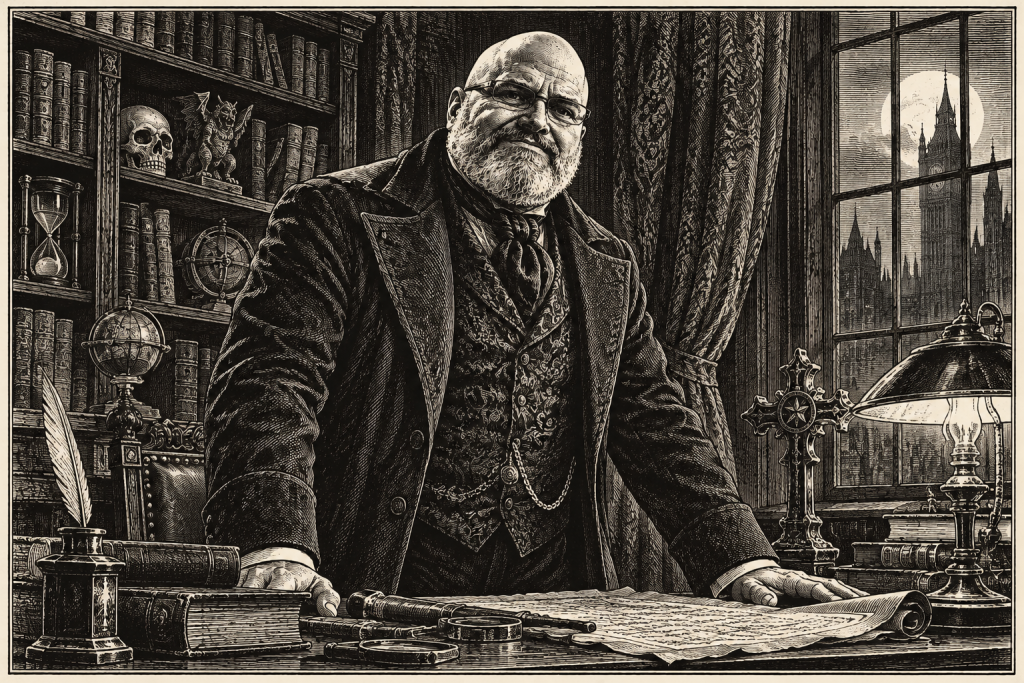
A dispatch of Abraham Van Helsing, upon the American republic in this present hour
In the course of long study—whether in the halls of medicine, among the records of the Un-Dead, or in direct contest with powers that move in shadow—I have observed that certain maladies of the spirit, though outwardly distinct, share a common mechanism of progressive consumption. It is in that spirit, and with no partisan intent, that I set beside one another the ancient condition of vampirism and that modern affliction which certain observers have termed Trump Derangement Syndrome. Both illustrate how an alien influence may enter through a small aperture, widen its hold by repeated visitation, and at length displace the ordinary powers of reflection. Both remind us that the contest between light and darkness is not confined to the graveyard. Mein Gott! such comparisons are undertaken that we may the better arm ourselves against whatever form the shadow next assumes.
Vampirism, as I have known it, is a post-mortem invasion. The body that should have rested is reanimated by an alien will; the natural motion of the blood is replaced by a hunger satisfiable only by the vital fluid of the living. The Un-Dead casts no reflection, for the soul that once animated the form has been displaced. He is strongest in darkness and is repelled by the Host, by garlic, by the crucifix, and by the open light of day. The bite is the instrument of contagion: a single puncture, insufficiently resisted, begins a progressive draining. With each visit strength diminishes, pallor increases, and the will is subordinated until, after death, the new vampire rises. Affections are inverted; what was once loved becomes a source of sustenance. Providence has set against this creature definite remedies—the stake, the severing of the head, garlic, the scattering of ashes—yet these avail only after the infection has claimed its victim. Prevention lies in the constant presence of the sacred symbols and in the refusal to yield the first drop of blood.
The affliction named Trump Derangement Syndrome begins, likewise, with a single puncture: an encounter with a narrative that presents its object as uniquely monstrous, beyond ordinary measures of disagreement. If the mind does not examine that account against the full body of evidence, the aperture remains open. Subsequent exposures—through newspapers, pamphlets, or gatherings of the like-minded—act as further visits, each reinforcing the impression and draining a measure of proportion. Disapproval becomes, by degrees, an absolute conviction that the object possesses no redeeming quality and no claim upon ordinary courtesy. Memory and comparison grow pale; contrary testimony is unseen or is itself transformed into further proof. The sufferer grows active chiefly when the restraints of daily labour are removed, turning the same accusations with a restless energy that feeds upon itself. Among those who share the fixation the conviction strengthens; in the presence of those who do not, a curious irritability appears, as though an opposing view were painful to the infected judgment.
The vectors differ—the fang in one case, the repeated utterance and social reinforcement in the other—yet the loss of reflective capacity follows in both. The vampire no longer sees himself in the glass because the human image has been displaced; the afflicted mind no longer sees its object in ordinary proportions because the obsessive narrative has displaced the instruments of measurement. Both prefer the shadow: the Un-Dead because the sun would reduce him to dust, the deranged judgment because the full daylight of contradictory fact would dissolve the sustaining passion. Natural bonds suffer in each. The vampire preys upon those nearest him; the deranged mind often turns first upon former associates who will not join the chorus.
The ontology, however, is not the same. The vampire has already crossed the threshold of death; the body is animated by a will no longer its own, and the remedies are physical and definitive. The derangement remains, while the body lives, a malady of mind and spirit. It confers neither animal transformation nor expulsion by the mere presence of a crucifix. Its remedy is the slower restoration of the faculties: recognition that judgment has been drained, deliberate re-examination of the original accounts against the full range of evidence, and recovery of proportion whereby disagreement is distinguished from absolute monstrosity. Providence may assist the willing mind, yet the will of the afflicted person remains indispensable. Where that will is absent, the capacity for ordinary fellowship may be largely lost even while the body continues to walk in daylight.
A further distinction appears in the social dimension. The Un-Dead works chiefly by individual predation; the derangement can become collective, entire circles reinforcing one another’s pallor of judgment and treating any attempt at restoration as betrayal. In such circles the instruments of reason—comparison, memory of contrary fact, refusal of an absolute where only degrees of policy exist—are set aside. The result is not merely private misery but a public distortion that consumes energy which might otherwise examine actual measures and consequences.
The parallels are therefore real: an initial aperture admits an influence that thereafter feeds upon its host, displacing reflection and drawing the victim toward the shadow. Contagion spreads by repeated contact, and social reinforcement multiplies the danger. Yet the distinction of essence remains decisive. One is a post-mortem animation of the body, to be met with the instruments Providence has placed in the hands of those who defend the living; the other is a pre-mortem occupation of the judgment, to be met with re-examination and the recovery of ordinary human measure. In neither case is the first yielding necessarily fatal, yet in both the progressive character of the consumption renders early resistance far more efficacious than late cure.
The form of the darkness changes with the age; the duty to name it and to resist it does not. Whether the vital principle under threat be blood or reason, the obligation remains to refuse the unexamined puncture, to keep the instruments of examination at hand, and to remember that the light given to rational souls is extinguished only by continued consent to remain in the shadow. This thing we must do—not in the heat of partisan passion, but in the steady gravity of those who know the contest to be perpetual. The Un-Dead we meet with stake and Host; the derangement of judgment we meet with the restored faculties of a free and examining mind. In both battles the victory belongs to those who keep the light burning and refuse to feed the shadow.
— Abraham Van Helsing