
Of the Vampires the Democrats Have Become
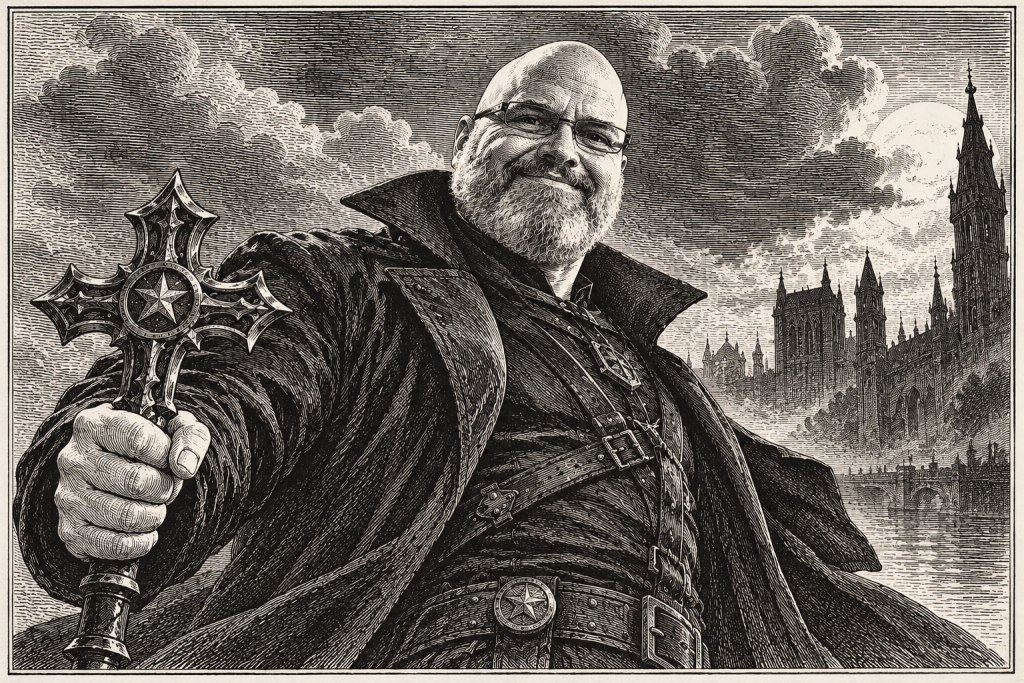
A dispatch of Abraham Van Helsing, upon the American republic in this present hour
There is a moment, ladies and gentlemen, when a disease ceases to be a fever and becomes a possession. The pulse still beats, the tongue still moves, the name is still spoken in the old halls of Congress as though it were a living creed. Yet the thing that answers to that name is no longer a party of measures. It is a hunger wearing a coat.
A learned correspondent of the law has said it with a physician’s brevity: the Democrats’ only policy position is calling you a racist. The observation is not a taunt flung in a tavern. It is a diagnosis. Present that party with a statute, a ledger, a corpse, a child, a border, a ballot-roll, a classroom that has become a census, and they do not meet you upon the ground of fact. They hiss the sacred word. They hold it before them as the peasant holds a crucifix, save that their relic has no Christ in it—only an accusation, and the power of the accusation to stop the living from speaking.
They react to an argument as the vampire reacts to the Cross. It is so.
I. The Nature of the Thing
A vampire is not merely a wicked man. A wicked man may still be argued with, for he has a soul that can be shamed. The Un-Dead has no such shame. He cannot endure the light because the light is the record of what he is. Daylight does not negotiate. Neither does a column of numbers, nor a name upon a police blotter, nor a green-card test that would ask whether the newcomer shall live upon the blood of those already here.
So the creature learns a liturgy. If a citizen mentions the revolving door of sanctuary, he is a bigot. If he mentions the girl in Maryland and the rideshare driver who should never have been upon these shores, he is cruel. If he mentions welfare kept off the test of citizenship by a coalition of Democrat states in the courts, he is heartless. If he mentions that crime, illegal immigration, and fraud are one chain, he has committed the unpardonable sin of noticing.
Notice is the Cross. They cannot bear it.
Let no subscriber imagine that every man and woman who still votes that ticket is himself a monster. God forbid that a physician should so slander the ordinary soul who clings to an old loyalty as a drowning man clings to a spar. The concern is the thing that now animates the machine: the habit of feeding upon moral terror instead of making a law that can survive the sun.
II. The Bite at the Border
Look you at the method, for the method is always the same.
The living nation has a skin. That skin is the frontier. When the skin is cut and left unstaunched, the night-walkers enter—not as guests, but as a climate. Catch and release is not mercy. It is an invitation written in disappearing ink. Sanctuary is not hospitality. It is a locked cellar in which the sheriff may not bring a lantern.
The public record of these last days has written it again in flesh. Illegal. Released. Again. A man from Guinea, admitted and loosed under the former administration, arrested in sanctuary New York for the violation of a child, loosed once more, and then charged with the rape of a young girl who trusted a hired carriage in Maryland. Failure at every bolt of the door. And still the same priests of the night tell the reader that to name the policy is to hate the stranger.
Mein Gott! The stranger is not the question. The question is whether a commonwealth may keep a door, and whether a girl of seventeen is less sacred than the liturgy of open-handedness.
The Laken Riley Act showed the roll. Most of that caucus preferred the door to remain a pretence. Give them the gavels again, and the doors open on purpose. This is not a change of mood, as the fashionable young men of the journals would have it. It is a continuation statute. The grave already has names. They would have the next names as well, provided only that no one is permitted to say how the names were made.
A Democrat House or a Democrat Senate is not a “vibes shift.” It is the restoration of a machine that has already been weighed and found wanting upon the streets.
III. The Treasury as the Open Vein
The vampire does not only drink in alleys. He drinks from the household accounts.
A republic that will not ask whether the newcomer shall carry his own water will soon discover that the well is not infinite. Democrat states have gone into court to keep welfare off the green-card test, as though public charity were a birthright that precedes citizenship and outranks the people who earned the surplus.
This is not compassion. Compassion looks a neighbour in the face and counts the cost. This is a feeding-tube run from the productive to the organised, and from the organised to the party that harvests gratitude as other men harvest wheat.
Decline is a choice. The great apparatus that manages homelessness is not a mystery of weather. It is a system that profits by managing failure, importing clients, and calling the manager virtuous. So too with the great pots of transfer: they create a priesthood whose sacrament is dependency and whose heresy is the man who can stand alone.
The Un-Dead hate the man who can stand alone. He does not bleed on command.
IV. The Skin-Suit and the Nest
There is a further horror, and the histories of revolution are full of it.
The old Democrat party still possesses the ballot line, the brand, the donors, the union halls, the inherited loyalties of honest workmen. Upon that living body a newer brood has settled. The Democratic Socialists and their kindred do not mean to reform the host. They mean to wear it. Abolish the Senate. Subordinate President and Court to a single chamber. Abolish the “carceral forces of the capitalist state.” Universal amnesty. Public ownership of the great concerns. “Deep international solidarity” spoken as if the American citizen were a temporary inconvenience upon a worldwide estate.
The minority leader congratulates the new brood as if they were merely another path to the same work. The crowd, for its part, has already learned to shout that he is next. It is the old law: the revolution eats its own. The Jacobins sent the Girondins to the scaffold. The Bolsheviks purged the Mensheviks. Yesterday’s ally is today’s heretic, and moderation is named counter-revolution.
They win the gentrified precincts where resentment has a graduate degree. They lose the working neighbourhoods by distances that would shame a general. This is not the rising of labour. It is an elite hunger that has learned to speak of the poor while feeding upon the institutions the poor still need: police, border, family, parish, shop.
A vampire nest does not argue with the castle. It occupies the castle and calls the occupation justice.
V. The Hypnotic Gaze
No Un-Dead works long without a servant who keeps the shutters drawn.
The press of this age has learned the mesmerist’s trade. A shooting is a parable if the parable wounds the Right; it is a vanishing if the parable wounds the liturgy. A diary of fame is “science” until the Fifth Amendment is taken a hundred and eleven times. An alarm over new engines of calculation is discovered the week the old issues—the cost of bread, the border, the war, the record—cease to serve the ticket.
When argument fails, they change the subject. When the subject will not change, they change the moral temperature of the room until only the accuser can breathe.
This too is vampiric. The Count does not always strike the throat first. First he makes the household doubt its own eyes. The subscriber who still trusts a headline as he would trust a parish register must learn again the old Victorian habit: read twice, and ask who profits by the darkness.
VI. Creaturehood Against Throughput
There is a better word for what is at stake than most of the philosophers of this hour have found: creaturehood.
A creature is a neighbour with a soul, a street, a school-yard, a vote, a load of work, a right not to be treated as a pipe through which someone else’s theory is pumped. Throughput is the opposite: the human unit as capacity, as vote-bank, as client, as demographic weather, as a pad of land that will accept racks and codes and new populations without being asked whether it remains a home.
Walk the line of any growing county and the classroom has become a census. Heritage was never a photograph; it was a people who assumed their children would inherit the same language of law. To say so is not hatred of the newcomer. It is fidelity to the living. The melting pot, if it is a pot at all, requires a fire of assimilation and a rim that does not melt with the metal. A republic that will not distinguish citizen from guest, parent from vendor, neighbour from throughput, has already offered its throat.
The Democrat machine of this hour prefers throughput. Throughput does not talk back. Throughput can be counted. Throughput can be told that the man who wants a door, a school that is his, a wage that is not a stipend, a sexed field of play for his daughter, is the true monster in the story.
VII. What the Cross Is
Now I come to the weapons, for a hunter who only names the disease is a gossip, and the public has a right to more than a shudder.
The Cross, in this quarrel, is not a metaphor for a party banner. God save us from that idolatry. The Cross is the thing the Un-Dead cannot counterfeit:
— the fact that will not blush
— the statute that can be read in daylight
— the border that is a law and not a mood
— the ballot-roll that belongs to citizens
— the family that is not a vendor on a federal ledger
— the state that is still a state, and not a prefecture of a single will in Washington
— the Constitution, which is garlic to every scheme that would dissolve Senate, Court, and sheriff into one hungry chamber
Federalism is not a hobby of antiquaries. It is the arrangement by which a free people keep many lamps burning, so that no single castle can darken the whole land. Limited government is not stinginess. It is the refusal to let a priesthood of experts drink without end from the common vein.
A man who will not name his own threshold will wake to find others naming it for him. That is as true in Texas as in New York, as true in a school vestibule as at a port of entry.
VIII. The Hour Before Dawn
I am not so foolish as to tell the reader that sunlight comes because we prefer it. The good God knows how many households have gone into the earth because they waited for a more convenient hour.
Yet this also is true: the creature is loudest when the night is oldest. The accusation of racism is not strength. It is the last sacrament of a church that has no other bread. A party that cannot defend its doors, its streets, its books, or its own moderates against the nest within, is already sickening on its diet.
The coming election is not a carnival of hatred—hatred is their food, not the food of a free people—but a work of distinction. Show the living what the Un-Dead cannot endure: argument, names, ledgers, the faces of the harmed, the old American insistence that a citizen is not raw material.
Hold the Cross to them. Not the painted one of party vanity, but the true one: truth spoken without a licence from the accuser.
They will hiss. They always hiss.
That sound, madam, sir, is not the sound of victory. It is the sound of a thing that has met the one object it cannot swallow.
Work, then. Watch. Do not be mesmerised. Keep garlic at the window and daylight on the page. The republic is still a living body. It is not required to offer its throat because a well-dressed hunger has learned to call the refusal a sin.
This thing we must do.
— Abraham Van Helsing